
Geometallurgy
Geometallurgy is a relatively new process in the mining industry, gaining momentum as a robust approach to improving ore processing, at the turn of the 21st century (Bueno et al., 2015, and references therein). The earliest studies in geometallurgy date back to the early 90’s when the need for significant improvement between mine and mill was realized (McKee, 2013). While the concept of geometallurgy is not new, the understanding of geological variability, which can then be linked to comminution testing made it practical (Lishchuk, 2016). Comminution (crushing and grinding) is often the bottle neck of the mine operation with increasing volumes of low-grade ore requiring far more energy to process. According to EY (2014) access to energy is increasingly difficult and very expensive. The overall global mining energy consumption has increased 260% since 2000, coupled with falling average grade (figures 1.1 and 1.2; EY, 2014)
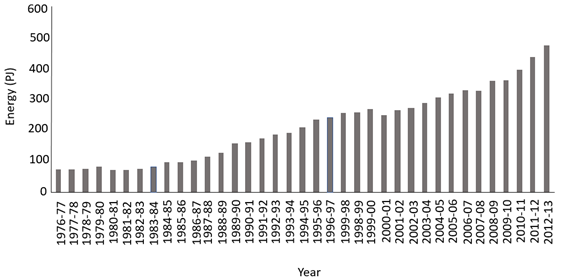
Figure 1.1: Energy consumption by the mining industry in Australia from 1976 through to 2013 (EY, 2014 and references therein).

Geometallurgy depends heavily on innovation of new technology and improvement of existing processing equipment (i.e. autogenous (AG), semi-autogenous (SAG), ball mills (BM)). It also depends on a strong geometallurgical program that seeks to combine the technology with understanding of geological variability to reduce costs and improving the financial windfall for the operator and investor. The geology model is very important, and it is a precursor to geometallurgical sampling selection. Geological input in sample selection is critical as the sample quantity can be made to reflect not only the mining sequence but proportional representation of the ore to be mined (Alruiz et al., 2009). The absence of this input in sampling campaign may affect the recovery and concentration. Large samples are required to further characterize the deposit by mineral texture which is linked to ore breakage property, hardness and mineral liberation. Characterizing minerals based on these attributes has two implications: it improves and predicts the performance of the mill, and allows prioritization of feed based on mineral processing requirements.
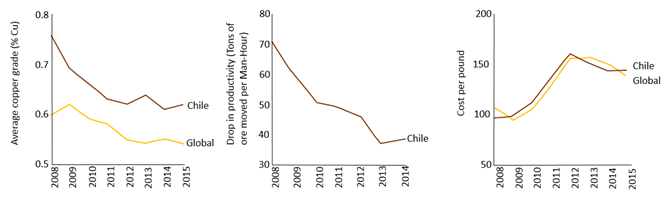
Figure 1.3: Plots of average copper grade, productivity and mine costs for Chile. Decreases in grade and productivity and rising costs are all motivational drivers to change in the way mining is done in the country. Improvements to energy efficiency and increased renewable energy use in mine operations. (COMPAÑÍA MINERA DOÑA INÉS DE COLLAHUASI, 2016).
Integrating geology with geometallurgical variables, albeit challenging, can be enhanced through continuous research and stochastic modelling, with the aim to reduce risks and maximizing project value. (Bueno et al., 2015).
Alruiz, O.M., Morrell, S., Suazo, C.J., Naranjo, A., 2009, A novel approach to the geometallurgical modelling of the Collahuasi grinding circuit: Minerals Engineering, v. 22, p. 1060-1067.
Bueno, M., Foggiatto, B., and G. Lane, 2015, Geometallurgy applied in comminution to minimize design risks [ext. abs.]: SAG conference, Vancouver, Canada, 2015, Extended Abstracts, p. 1-19.
COMPAÑÍA MINERA DOÑA INÉS DE COLLAHUASI, 2016, Sustainable development report, 126 p. accessed via URL (http://www.collahuasi.cl/wp-content/uploads/2016/05/REPORTE-COLLAHUASI-2015-EN.pdf).
EY, 2014, Renewables in mining: futuristic or realistic? accessed August 3, 2017, via URL http://www.ey.com/Publication/vwLUAssets/EY_Renewables_in_mining_futuristic_or_realistic/$FILE/EY-Renewables-in-mining-futuristic-or-realistic.pdf
Lischuk, 2016, Geometallurgical programs – critical evaluation of applied methods and techniques: Unpublished Licentiate Thesis, Luleå, Sweden, Luleå University of Technology, p. 126
McKee, D.J., 2013, Understanding mine to mill: Brisbane, The Cooperative Research Centre for Optimizing Resource Extraction, 96p.