
Mikheevskoye Case study
The Mikheevskoye deposit is located in Chelyabinsk region, Russian. First discovered in 1952, was subject to intensive exploration program since. After many years of exploration and drilling, resource estimation was completed in Australasian Joint Ore Reserves Committee Code (JORC) and proven to be in C1 and C2 category in Russian reporting code (figure 4.1.1). Estimate resource stands 352 Mt at 0.41%, amenable to open cast mining. The project was commissioned in 2013, and prior that date was greenfield project. (Lishchuk, 2014).
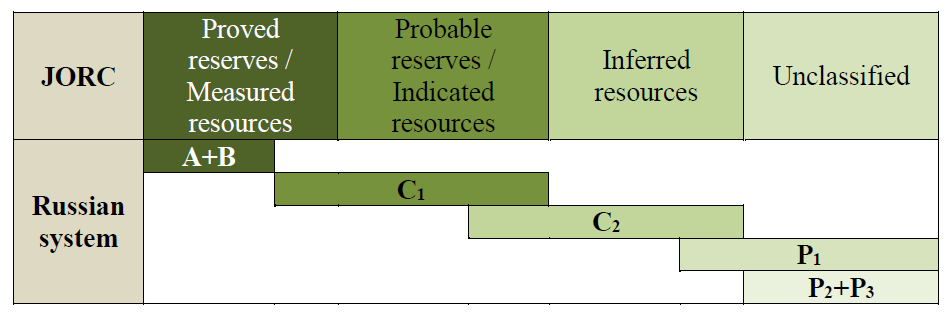
Figure 4.1.1: Mineral resources at Mikheevskoye deposit were proved to be C1 and C2 category (Lishchuk, 2014).
Mikheevskoye is a Cu-porphyry deposit, hosted in Devonian volcano-sedimentary rocks of andesitic to basaltic composition superimposed with early carboniferous volcanic basalt. The deposited is aged to 356 ± 6 years (Lishchuk, 2014). The Paleozoic host rock are crosscut by diorite and quartz diorite related intrusion, accepted as early carboniferous age.
Is classic porphyry deposit described in Sillitoe (2010), and comprise inner potassic and outer propylitic alteration zones (Figure 2). The deposit has large alteration footprint, 6 km length and 800 m width with variable degrees of the alteration, particularly in the upper part where the strong acid rocks tend to display strong sericitation and chlorite. The boundaries between different alteration sequences can be gradual and at time difficult to discern (Lishchuk, 2014). The zones of phyllic and argillic (clay rock) alteration are the part of the zonal pattern between the potassic and propylitic zones.
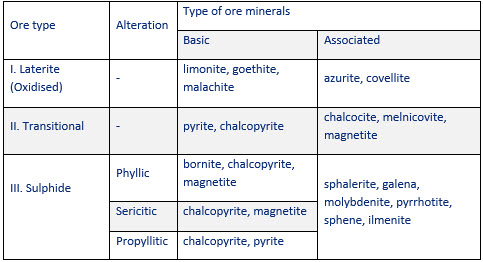
Early mineralization may have formed early Carboniferous related dikes of andesitic and basaltic composition that intruded into Devonian volcanic sediment. The mineralization tends to be zonally distributed and display outward progression with chalcopyrite and bornite forming in the core centre, followed by chalcopyrite, followed by pyrite and chalcopyrite and finally pyrite in the outer layer (figure 4.1.2.1). Weathering profile of the deposit, from oxidized to transition to hypogene mineralization zone or as refer to primary rock is also shown in figure 4.1.2.2 and table 4.1.2.1. (Lishchuk, 2014).
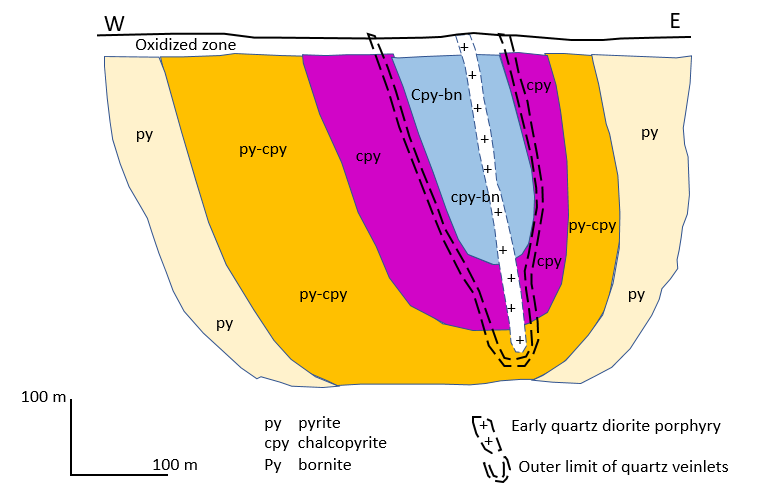
Figure 4.1.2.1: Sulphide mineral types and distribution at Mikheevskoye deposit (Lishchuk, 2014).
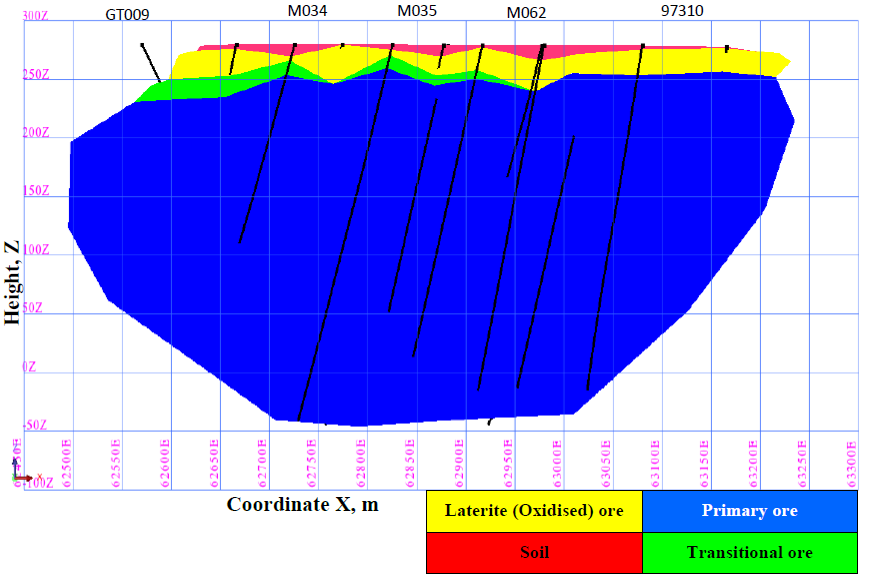
Figure 4.1.2.2: weathering profile of Mikheevskoye deposit (Lishchuk, 2014).
Table 4.1.2.1: Mineral types corresponding to degree of weathering from top down (Lishchuk, 2014).
Geometallurgy
Geometallurgical program was established to reflect the mineral variation in the orebody. Hydrothermal zones were integrated with metallurgical variables to create a predictive model that will reduce processing cost. Prior to this study there were no geometallurgical model and according to Lishchuk et al. (2015) the geological data were of little use in the processing plant. Two hypotheses were set for testing. Scenario 1 was the deterministic/ mine model based on head grade (figure 4.1.3.1) and scenario 2 was a geometallurgy based model (figure 4.1.3.2).
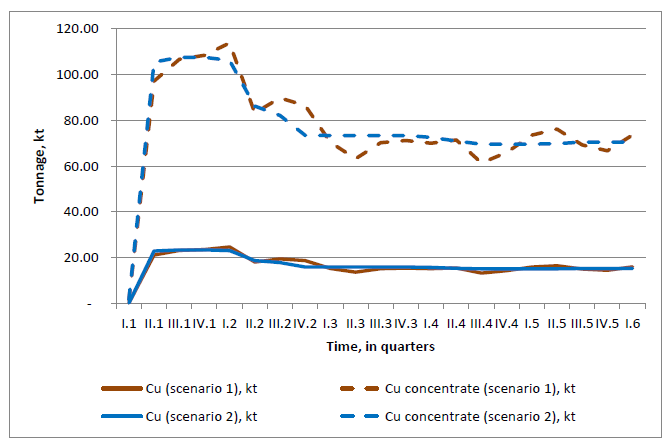
Figure 4.1.3.1: Concentrate and copper production capacities according to scenarios 1 and 2 (Lishchuk, 2014).
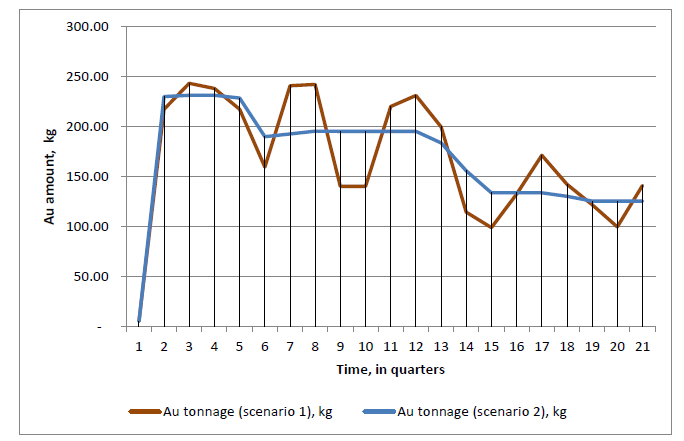
Figure 4.1.3.2: Gold production capacities according to scenarios 1 and 2. (Lishchuk, 2014).
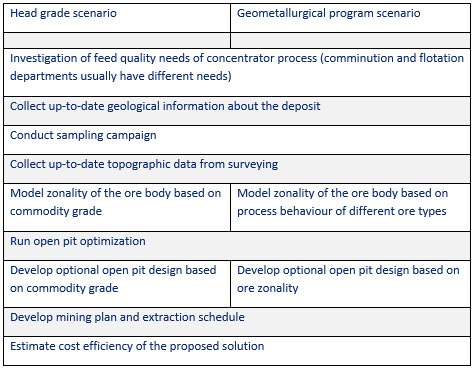
The geometallurgy domain were set to reflect homogeneity of the deposit based beneficiation process and mine model remain unchanged (Lishchuk et al., 2015). The objective for each of the model is summarized in table 4.1.3.1.
Table 4.1.3.1: Objectives of the head grade and geometallurgical program scenarios
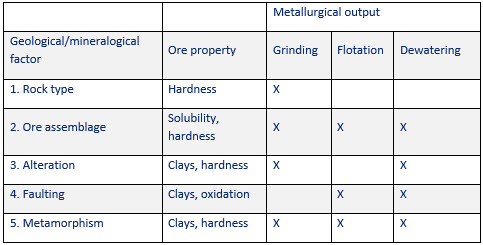
For geometallurgical model to work, it was link to geological model and incorporated with metallurgical parameters summarized in table 4.1.3.2.
Table 4.1.3.2: Linkage between geological and metallurgical factors (Lischuk et al., 2015).
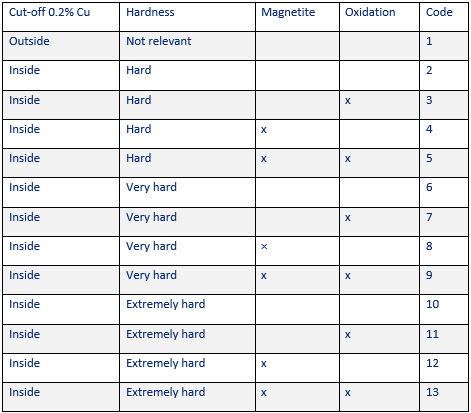
The initial phase of mineral processing indicated what appears to the primary control of the orebody such as the presence of oxidation, magnetite, and variety of these two result some 13 geometallurgical domains as summarized in the table 4.1.3.3.
Table 4.1.3.3: Geometallurgical domains suggested for Mikheevskoye mine (Lischuk et al., 2015).
The two models, the head grade based and geometallurgical model were estimated for reliability. The head grade based model assume processing cost at a constant cost while geometallurgical model anticipate modifying cost based upon difference in processing cost. The two models were tested on one year projected production and determine the geometallurgical model is reflective of the geological variability of the deposit and projected to speed up the payback period by 1.5 years.
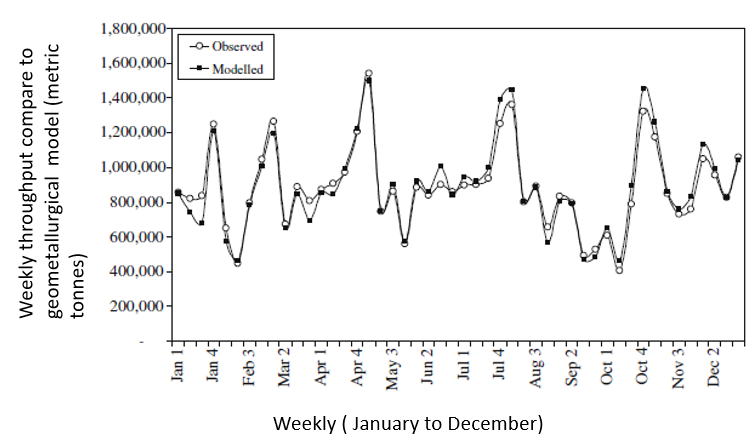
Figure 4.2.3.2: Weekly throughout compared to the geometallurgical model for one full year (Alruiz et al., 2009).
Lishchuk, V., 2014, Porphyry ore body zonality for the mine planning in context of processing performance: Unpublished M.Sc. Thesis, Espoo, Finland, Aalto University, 117 p.
Lishchuk, V., Koch, P-H., Lund, C, and Lamberg, P., 2015, The geometallurgical framework. Malmberget and Mikheevskoye case studies: Mining Science, v. 22, p. 57-66.
Lischuk, 2016, Geometallurgical programs – critical evaluation of applied methods and techniques: Unpublished Licentiate Thesis, Luleå, Sweden, Luleå University of Technology, p. 126
Sillitoe, R.H., 2010, Porphyry Copper Systems: Economic Geology, v. 105, p. 3-41.