
Historically, geology and mineralogy and comminution, the key pieces of the puzzle that control mineral processing, were only individually considered, but never collectively. Comminution circuits were designed and operated to provide targeted product fineness, or the 80th per centile, and this discrete number was rarely changed. This was reexamined in the late 20th century, however, once the mining industry began experiencing appreciable decreases in grade and recovery, and increased comminution. (Lund et al., 2014). The widely used geometallurgical tests for measuring mineral hardness (bond mill work index – BWi), and mineral competency (drop weight test -DWi) or breakage (A*b), have growing importance to understanding the physical and chemical nature of minerals which the mill performance index is based. By better understanding the geology, mineral processing, and mineralogy as a function of particle size, the comminution and recovery performance is more precisely quantified (Sepulveda et al., 2017).
A geometallurgical model should not only predict the metallurgical response, but also give the best possible parameters to target mineral liberation, with respect to target grinding fineness for any given rock. In the case of the Collahuasi and Mikheevskoye deposits, a combination geometallurgical test with sufficient and appropriate samples, and relevant characterization of the comminution, coupled with simulation techniques culminated in successive models. (Alruiz et al., 2009; Lishchuk, 2014; Lund et al., 2014).
The use of geometallurgical data in the models can vary with widely different outcome. The recently completed Mikheevskoye deposit geometallurgical model is currently in the testing phase and not yet implemented (figure 5.1; Lischuk, 2016), whereas the geometallurgical model developed from 2008 to 2012 for the Collahuasi deposit, has been tested and is now fully implemented for plan and forecasting throughput at the mill (Alruiz et al., 2009). The Collahuasi model was rigorously tested against production true tons and grade, and the model is considered to be very robust, with an approximate error of 5.2% (figure 5.1; Alruiz et al., 2009)
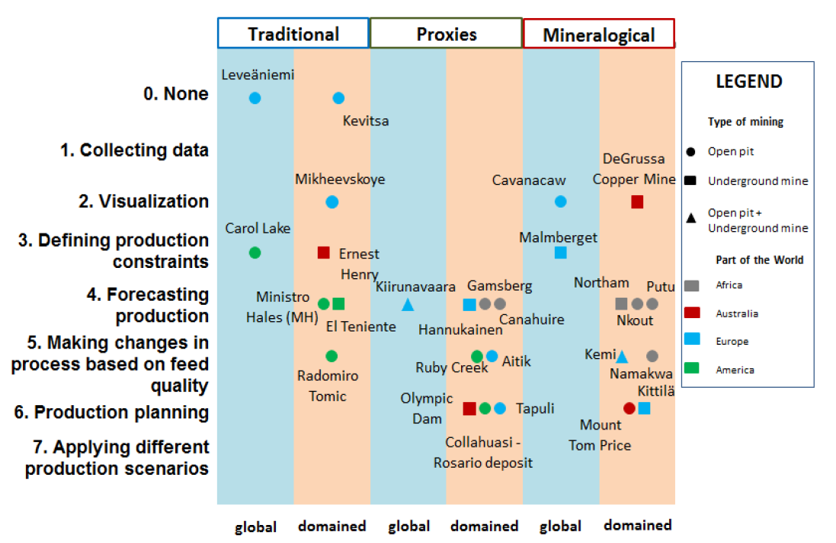
Figure 5.1: Selected mines arranged in classification matrix (Lischuk et al., 2015).
The geometallurgy sampling in early stages of project can be limited in terms of sampling numbers and size but nonetheless can be very important. This early sampling can indeed prevent unforeseeable problems down the line, but additional large sampling programs can be useful in defining the geometallurgical domains. Furthermore, defining geometallurgical domain and mining the ore with the least amount complexity will maximize profit and shorten the payback period (Lischuk et al., 2015).
At current moment, there is no encompassing geometallurgical model that is agreed in the mining industry. There are multiple geometallurgical model types with variable input parameters and the reliance and use also vary as summarized in the above figure 5.1, from operation to operation. Some models are used for visual while others are used in production planning and forecasting, figure 5.1.
Alruiz, O.M., Morrell, S., Suazo, C.J., Naranjo, A., 2009, A novel approach to the geometallurgical modelling of the Collahuasi grinding circuit: Minerals Engineering, v. 22, p. 1060-1067.
Lishchuk, V., 2014, Porphyry ore body zonality for the mine planning in context of processing performance: Unpublished M.Sc. Thesis, Espoo, Finland, Aalto University, 117 p.
Lishchuk, V., Koch, P-H., Lund, C, and Lamberg, P., 2015, The geometallurgical framework. Malmberget and Mikheevskoye case studies: Mining Science, v. 22, p. 57-66.
Lischuk, 2016, Geometallurgical programs – critical evaluation of applied methods and techniques: Unpublished Licentiate Thesis, Luleå, Sweden, Luleå University of Technology, p. 126
Lund, C., and Lamberg, P., 2014, Geometallurgy – a tool for better resource efficiency: Journal of the European Federation of Geologists, v. 37, p. 39-43.
Sepulveda, E., Dowd, P.A., Xu, C., and Addo, E., 2017, Multivariate modelling of geometallurgical variables by projections pursuit: Mathematical Geoscience, v. 49; p. 121-143.